Physical Address
304 North Cardinal St.
Dorchester Center, MA 02124
 Skip to content
Physical Address
304 North Cardinal St.
Dorchester Center, MA 02124

Your favorite sports world
Your favorite sports world
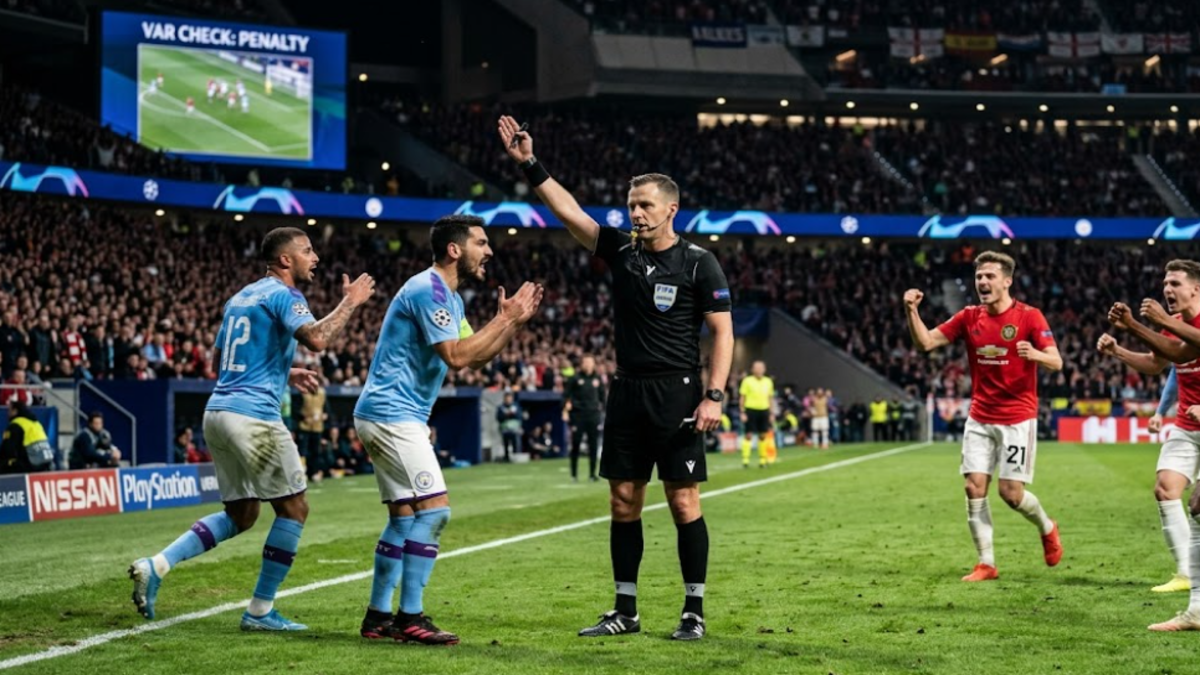
LONDON – Sport 4 ever: How Referees Make Decisions During High-Pressure Games

When a football match reaches its decisive minutes, players are not the only ones under pressure. Referees must process tackles, handballs, possible penalties, disciplinary offences and appeals from both teams while thousands of supporters react to every whistle. Recent reporting and continuing debates around VAR have once again placed officiating at the centre of football’s biggest conversations, but what actually happens inside a referee’s mind when one decision could change an entire match?
Refereeing at the highest level is built around speed, preparation and concentration. Officials cannot stop the game every time they need to think about a decision. In many situations, they have only a fraction of a second to judge what happened and decide whether an offence occurred.
The first decision is normally made by the referee on the field. This remains important even in matches using video technology. The International Football Association Board’s VAR protocol states that referees must make an initial decision rather than deliberately waiting for video assistance.
That principle reflects an important reality of modern officiating: technology is designed to assist the referee, not replace the referee.

The official must judge the incident from the position available at that moment. Distance, angle, speed of play and the movement of other players can all affect what the referee sees.
A tackle that looks obvious from a television replay may appear very different when viewed once, at full speed, from ground level. Television viewers can also benefit from slow motion, multiple camera angles and repeated replays that are unavailable to the referee during the initial incident.
This is why experienced officials spend years learning not only the Laws of the Game but also positioning. Being in the correct place can be as important as knowing the rule itself.
A referee who is several metres closer to an incident may have a much clearer view of whether contact was accidental, careless, reckless or serious enough to deserve a stronger punishment.
Pressure increases when the score is close and the clock is running down. A penalty in the opening minutes and a penalty in stoppage time may involve exactly the same rule, but the second decision can attract dramatically more attention.
Players know the importance of the moment. Coaches are often demanding answers from the technical area. Supporters react loudly, while television audiences watch from multiple angles.
The referee still has to separate all of that noise from the incident itself.
This is one reason professional officials train extensively before major competitions. Recent reporting on elite referees has highlighted how much physical preparation is required because officials must maintain concentration while covering long distances and repeatedly changing direction.
Physical fitness is directly connected to decision-making. A tired referee may struggle to keep the correct position late in a match, potentially leaving the official further from important incidents.
The pressure is also psychological. Referees have to make decisions that will inevitably please one side and anger the other. The ability to accept that reaction without changing the next decision is a crucial part of the job.
The best officials do not try to win approval from players or supporters. Their task is to apply the rules consistently.
Video Assistant Referee technology has changed the way major football matches are officiated, but it has not removed human judgment.
Under the VAR protocol, the video team automatically checks incidents within the areas covered by the system. Intervention is restricted to specific situations, including goals and offences leading to goals, penalty decisions, direct red cards and cases of mistaken identity.
The system is therefore not intended to correct every decision that somebody believes was wrong.
Instead, the central principle is the correction of a clear and obvious error or a serious missed incident. The original decision remains in place unless the review provides sufficient evidence to change it.
That distinction is important because football contains many decisions that involve interpretation rather than simple facts.
For example, determining whether a player made illegal contact can require an assessment of the nature of the challenge, the circumstances and the player’s actions. A replay can show exactly where contact occurred, but the referee must still apply the relevant law.
The final decision also remains with the referee. The VAR can recommend a review, but the referee is responsible for the final call.
One of the biggest differences between watching a match at home and officiating it on the field is time.
A television viewer may see an incident from five or six angles within seconds. The replay can be slowed down, paused and shown repeatedly. The referee does not have that luxury when making the original decision.
This creates a familiar problem. A challenge may look extremely serious in slow motion because the viewer can study the exact moment of contact. At normal speed, however, the movement may have happened almost instantly.
That does not mean replay analysis is useless. Quite the opposite. VAR exists because certain incidents are difficult to judge correctly in real time.
But it explains why an apparently obvious decision to a viewer may not have been obvious to the referee at the moment it happened.
The debate over VAR has repeatedly focused on this tension. Supporters of the system argue that technology can improve accuracy. Critics say long reviews can interrupt the rhythm of the match and leave supporters uncertain about whether they can celebrate.
Former referees and analysts have also stressed the importance of understanding the distinction between an incorrect decision and a decision that falls within the range of reasonable interpretation.
That distinction is central to modern refereeing.
Decision-making is not limited to whistles and cards. Communication can prevent situations from becoming more difficult.
A referee constantly communicates with players through gestures, voice and positioning. Sometimes a calm explanation can stop a player from repeatedly challenging a decision.
At other moments, the referee must be firm.
The objective is not to dominate the players but to maintain control of the match. If an official allows repeated dissent or aggressive behaviour to go unchecked, the atmosphere can become harder to manage.
The same applies to confrontations between players. Referees must recognize when a dispute is likely to escalate and intervene before it becomes a larger disciplinary problem.
This is particularly difficult in high-profile games because the players themselves are under enormous emotional pressure.
The referee therefore acts as both decision-maker and match manager.
That broader role helps explain why elite refereeing is more complicated than simply knowing whether a foul has occurred.
The decisions seen by supporters during a major match are the product of preparation that begins well before the referee walks onto the pitch.
Officials study the Laws of the Game, review previous performances and prepare physically. They also work with other members of the officiating team.
Assistant referees provide additional views, while the fourth official manages issues around the technical areas. In competitions using video technology, VAR and assistant VAR officials form another part of the officiating structure.
The Laws make clear that these officials work under the direction of the referee, with the final decision remaining with the referee.
This team structure is particularly important in matches where incidents happen in different parts of the field almost simultaneously.
The referee cannot see everything.
Trust between officials allows information to move quickly. An assistant may have a better view of an offside position, while another official may see an incident away from the referee’s line of sight.
The referee then has to process that information without losing control of the match.
Modern referees also operate in an environment where every major decision can become a news story.
Controversial decisions are dissected by former players, television analysts, newspapers and social media users. A single incident can dominate coverage for days.
Recent football reporting has shown how quickly pressure can build around officials following disputed VAR decisions. In England, debates over video technology have included criticism from managers and clubs, while governing bodies have repeatedly tried to explain how the system should be used.
The problem is not simply criticism.
Officials must also deal with the possibility that players will attempt to influence their decisions. Appeals are part of football, but referees are trained to distinguish genuine information from deliberate attempts to gain an advantage.
A player shouting for a handball does not prove that a handball occurred. A defender claiming innocence does not automatically make the challenge legal.
The referee has to remain focused on the evidence.
One of the most important qualities of a referee is the ability to move on.
Even an excellent official can make an error. The danger comes when one mistake affects the next decision.
If a referee begins trying to compensate for an earlier call, consistency can disappear. A decision made in the 20th minute should not dictate how a similar incident is judged in the 70th minute.
Professional refereeing therefore requires emotional control.
The official must acknowledge information, communicate with the team when necessary and then concentrate on the next phase of play.
VAR can assist with certain major incidents, but it cannot remove every uncertainty from football. The system itself depends on human judgment, and research into video-assisted refereeing has continued to examine how technology and human officials interact during difficult decisions.
Football has become increasingly sophisticated, but refereeing remains fundamentally human.
Technology can provide more information. Cameras can offer additional angles. Communication systems can connect officials. Fitness testing can help ensure referees remain physically capable of following play.
None of those tools can completely eliminate interpretation.
A referee must still decide what happened, whether the action breached a law and what sanction, if any, is appropriate.
That is why high-pressure refereeing is a combination of knowledge, positioning, fitness, communication and psychological control.
The most difficult moments are often not the spectacular ones. They can be the ordinary-looking incidents that happen quickly, when the referee has only a moment to decide whether to stop play.
At the highest level, preparation is designed to make that decision as clear as possible.
Supporters rarely agree about refereeing. That is part of sport.
One team’s controversial penalty is another team’s justified decision. One supporter sees strong officiating; another sees a mistake.
For referees, consistency is therefore more important than popularity.
The objective is to apply the same principles to both teams regardless of the score, the venue, the reputation of the players or the importance of the match.
This becomes especially difficult when the game reaches its final stages and emotions are at their highest.
A referee who can remain calm when a stadium is demanding a penalty has a major advantage over one who becomes influenced by the atmosphere.
The modern game has added another layer of scrutiny through VAR, but the fundamental challenge remains unchanged: officials must make the best decision possible with the information available.
The debate around refereeing is unlikely to disappear. As technology develops, football authorities will continue to consider how much responsibility should remain with officials on the field and how much should be supported by video systems.
Recent discussions within football have shown that there are competing views. Some believe the sport should pursue increasingly accurate decisions, while others argue that football must preserve the speed, emotion and human character that make it distinctive.
The challenge is finding the right balance.
Referees will continue to make mistakes because football happens at extraordinary speed. VAR can correct some errors, but it cannot turn every subjective judgment into an objective fact.
What remains essential is the quality of the people making the decisions.
Their preparation, concentration and ability to withstand pressure can determine whether a difficult match remains under control.
For supporters, the next controversial call may look like a simple moment. For the referee, it is the culmination of years of training, split-second observation and responsibility under intense scrutiny.
How quickly must referees make decisions?
Many decisions must be made almost instantly, particularly during fast attacks and challenges.
Does VAR make the final decision?
No. VAR can recommend a review, but the referee makes the final decision.
Why do referees train so much physically?
Fitness helps officials maintain the correct position and concentration throughout the match.
Can VAR eliminate refereeing mistakes?
No. It can correct certain clear errors, but many football decisions still involve human interpretation.