Physical Address
304 North Cardinal St.
Dorchester Center, MA 02124
 Skip to content
Physical Address
304 North Cardinal St.
Dorchester Center, MA 02124

Your favorite sports world
Your favorite sports world
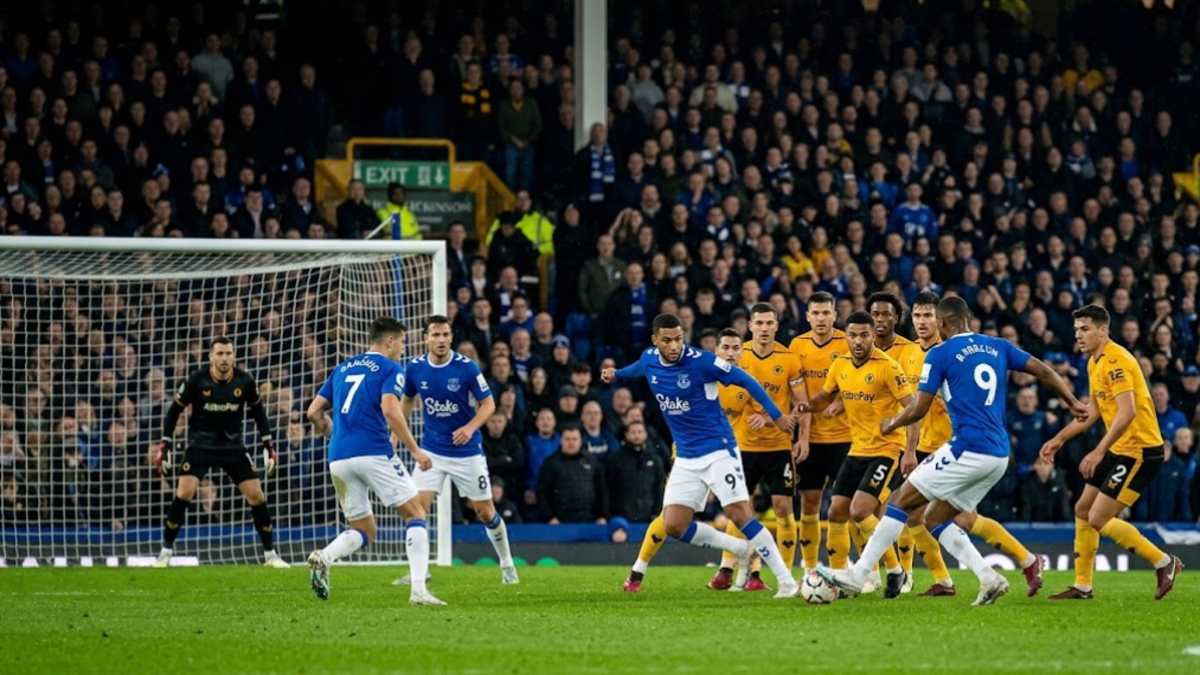
Liverpool – ABN News: Everton vs Wolverhampton Wanderers remained goalless at Hill Dickinson Stadium as Everton controlled much of the opening exchanges in their Carabao Cup Round Three tie, but Wolves continued to defend firmly and keep the contest within reach. With Everton creating the clearer opportunities and dominating possession, could the home side finally turn its territorial advantage into the goal needed to break the deadlock?

Everton entered the Carabao Cup meeting with Wolverhampton Wanderers looking to build on a positive sequence of results, while Wolves arrived after a 1-0 away victory over Sheffield United in the Championship.
The match at Hill Dickinson Stadium was still level at 0-0 in the latest live update, but the statistics showed a clear difference in how the two teams had approached the opening stages.
Everton held 58.7 percent possession compared with 41.3 percent for Wolves. That advantage was also reflected in the passing numbers, with Everton completing 217 passes from 237 attempts for an accuracy rate of 91.6 percent.
Wolves, by comparison, completed 140 of 167 attempted passes, recording an accuracy rate of 83.8 percent.

The figures suggested that Everton had enjoyed more control of the ball and had been able to move possession around the pitch with greater consistency.
That control, however, had not yet produced the breakthrough the home side wanted.
Everton had registered four shots, including one on target. Wolves had managed only one attempt, which was off target.
The home side had also entered the opposition penalty area 11 times, compared with just two touches inside the Everton box for Wolves.
Everton had won two corners, while Wolves had yet to earn one.
Despite those differences, the score remained 0-0, leaving the tie open.
Everton’s four attempts represented the greater attacking output, although the statistics also showed that Wolves had managed to prevent the hosts from turning possession into a sustained stream of shots on target.
Everton had one shot on target and one shot off target, while two further attempts had been blocked.
The home side had also missed one big chance.
That statistic stood out because it represented Everton’s clearest opportunity to take control of the contest on the scoreboard. With the match still goalless, the missed chance had become an important part of the story.
Wolves had recorded one shot, but it had not troubled the Everton goalkeeper enough to result in a save being recorded.
Neither goalkeeper had made a save according to the latest statistics.
That detail illustrated the nature of the match. Everton had been the more active side in possession and territory, but Wolves’ defensive work had prevented the pressure from becoming a goal.
Everton had created one chance, while Wolves had created none in the recorded statistics.
The hosts had also attempted five crosses and completed one, giving them a crossing accuracy of 20 percent.
Wolves had attempted four crosses and completed one, producing a 25 percent crossing accuracy.
Neither team had hit the woodwork.
The attacking numbers therefore pointed toward an Everton side doing more of the work in the final third, while Wolves had concentrated on remaining compact and limiting the quality of the chances.
The visitors had also recorded two blocked defensive efforts and made nine clearances, compared with six from Everton.
That difference offered another indication of how frequently Wolves had been required to deal with Everton’s attacking moves.
Wolverhampton Wanderers had struggled to match Everton’s attacking statistics, but the visitors had not allowed the match to move away from them.
Their 41.3 percent possession was significantly below Everton’s figure, yet they had competed evenly in the overall duel statistics.
Both teams had won 13 duels, giving each side a 50 percent overall duel success rate.
The ground-duel numbers were more favourable to Wolves. The visitors had won 13 ground duels compared with nine for Everton, producing a 59.1 percent success rate against Everton’s 40.9 percent.
Everton had enjoyed the advantage in the air.
The hosts had won four aerial duels, giving them a 100 percent success rate in the recorded statistics, while Wolves had not won an aerial duel.
The figures presented a contrast between the two teams. Everton had controlled possession and had enjoyed greater attacking territory, while Wolves had shown competitiveness in individual ground battles and had continued to restrict the hosts’ opportunities.
Wolves had also completed two successful dribbles from three attempts, giving them a 66.7 percent dribble success rate.
Everton had completed one successful dribble from two attempts, a 50 percent success rate.
Neither side had been able to convert those individual moments into a goal.
The defensive statistics showed a similarly close contest in some areas. Everton had made 19 recoveries and four interceptions, while Wolves had recorded 16 recoveries and five interceptions.
Everton had made six clearances, including three headed clearances. Wolves had made nine clearances and four headed clearances.
The visitors had therefore been required to clear the ball more frequently, but they had succeeded in keeping the score level.
The disciplinary picture was also even.
Everton and Wolves had each received one yellow card, while neither team had been shown a red card.
Everton had committed six fouls and won five, while Wolves had committed five fouls and won six.
The numbers indicated a competitive but controlled match, with neither side yet facing the disruption that would come from a dismissal.
The absence of a red card was particularly relevant in a match where one goal could change the entire tactical situation.
A breakthrough for Everton would force Wolves to take more attacking risks, while a Wolves goal would immediately change the pressure on the hosts and potentially leave Everton chasing the tie.
For the moment, neither scenario had occurred.
The match remained goalless, and the statistics continued to favour Everton in terms of possession, passing and attacking territory.
The visitors, however, had remained within one decisive moment of changing the picture.
Everton’s recent form provided additional context to the match.
Before the Carabao Cup tie, Everton had drawn 0-0 away to Tottenham Hotspur.
That result followed a 2-2 home draw against Manchester United and a 1-1 away draw against Bournemouth.
The team had also recorded a convincing 4-0 away victory over Preston in the previous round of the Carabao Cup.
Before that cup victory, Everton had beaten Crystal Palace 2-0 at home.
The sequence showed a side that had remained unbeaten across its most recent competitive fixtures listed in the supplied data.
Everton had scored four goals against Preston and two against Crystal Palace, while keeping clean sheets in both matches.
The goalless draw against Tottenham had also demonstrated the defensive side of their recent form.
The challenge against Wolves was therefore not simply about possession. Everton were also attempting to continue a run in which they had avoided defeat while progressing further in the domestic cup.
The 4-0 victory over Preston had taken Everton into Round Three, setting up the meeting with Wolves.
With the score still 0-0, the immediate task was to turn the statistical advantage into another cup victory.
Wolverhampton Wanderers had also experienced a busy sequence of matches before arriving at Hill Dickinson Stadium.
Their most recent match had ended in a 1-0 away victory against Sheffield United.
Before that, Wolves had drawn 2-2 away to Birmingham City.
They had suffered a 4-2 away defeat against West Ham United, but responded with a 4-1 home victory over Stoke City.
Their previous Carabao Cup match had produced another positive result, with Wolves winning 2-0 away against Sheffield Wednesday.
They had also beaten Preston 3-1 away earlier in the campaign.
The results showed a side capable of producing goals but also one that had experienced contrasting outcomes during the run of fixtures.
Wolves had scored four against Stoke and three against Preston, while their 4-2 defeat to West Ham demonstrated that the team could also concede heavily.
Against Everton, however, the visitors had so far succeeded in preventing another high-scoring contest.
The 0-0 scoreline meant that Wolves remained one moment away from potentially taking the initiative.
One of the clearest statistical differences between the teams came in passing.
Everton had attempted 237 passes and completed 217, giving them an accuracy of 91.6 percent.
Wolves had attempted 167 passes and completed 140, producing an accuracy rate of 83.8 percent.
The difference was significant because Everton had not only held more possession but had also used that possession efficiently.
The hosts’ passing accuracy helped explain why they had spent more time in control of the match.
Everton’s 11 touches in the opposition box compared with Wolves’ two further illustrated the difference in territory.
However, possession alone could not decide the tie.
Everton still needed to convert that control into goals.
Their single shot on target showed the limitation of their attacking production despite the territorial advantage.
Wolves, meanwhile, had focused on maintaining their defensive shape and looking for opportunities to counter.
With the match still level, the next attacking sequence could prove important.
As the contest remained goalless, both managers faced a familiar cup-match dilemma.
Everton had the statistical advantage but needed greater efficiency in the final third. Wolves had produced less going forward but had successfully kept the hosts from scoring.
The longer the score remained 0-0, the greater the importance of the next clear opportunity.
Everton’s one missed big chance already underlined how narrow the margins could become.
The hosts had also been caught offside twice, suggesting that they were attempting to push runners beyond the Wolves defensive line.
Wolves had not been caught offside in the recorded statistics.
That difference again reflected the contrasting approaches, with Everton spending more time trying to advance into dangerous areas while Wolves remained more conservative.
Everton had attempted five crosses, while Wolves had attempted four.
Neither side had hit the woodwork, and neither goalkeeper had been credited with a save.
The numbers therefore described a match in which Everton had established territorial superiority without producing the kind of repeated shots on target that normally accompanies sustained pressure.
The physical contest had remained relatively even.
Both teams had won 13 duels, with an overall success rate of 50 percent apiece.
Wolves’ advantage in ground duels was balanced by Everton’s superiority in aerial challenges.
The visitors had also completed more successful dribbles, with two compared with Everton’s one.
Everton, however, had continued to recover possession effectively, recording 19 recoveries against Wolves’ 16.
Interceptions were also close, with Wolves recording five and Everton four.
Those numbers showed that the match had not been dominated in every area by the home side.
Everton’s main advantage had come through possession, passing and territory rather than an overwhelming physical superiority.
That distinction mattered because Wolves remained capable of disrupting Everton’s rhythm whenever the home side attempted to move into the final third.
The latest scoreline left everything unresolved.
Everton had the larger share of possession, more shots, more shots on target, more corners and significantly more touches inside the opposition penalty area.
Wolves had fewer attacking statistics but had remained level and had won more ground duels.
Everton’s 91.6 percent passing accuracy also demonstrated their control of the ball, while Wolves’ 83.8 percent figure reflected a more direct and defensive approach.
The most important figure remained the score.
At 0-0, Everton’s statistical advantage had not yet translated into a lead.
For Wolves, that meant the defensive strategy had achieved its immediate objective.
For Everton, the next priority was clear: find a way through a defence that had already produced nine clearances and limited the visitors’ own attacking exposure.
The match remained live, and the latest statistics offered no indication that the outcome had been settled.
With neither goalkeeper yet forced into a recorded save, one well-executed attack could change the entire contest.
For supporters following the match, the key question was whether Everton’s possession and territorial control would eventually produce the breakthrough or whether Wolves could continue to withstand the pressure.
The latest score provided for the live Carabao Cup Round Three match is Everton 0-0 Wolverhampton Wanderers.
The match is being played at Hill Dickinson Stadium.
Everton have had more possession, with 58.7 percent compared with Wolves’ 41.3 percent.
Everton have recorded four shots, including one on target. Wolves have recorded one shot, which has been off target.