Physical Address
304 North Cardinal St.
Dorchester Center, MA 02124
 Skip to content
Physical Address
304 North Cardinal St.
Dorchester Center, MA 02124

Your favorite sports world
Your favorite sports world
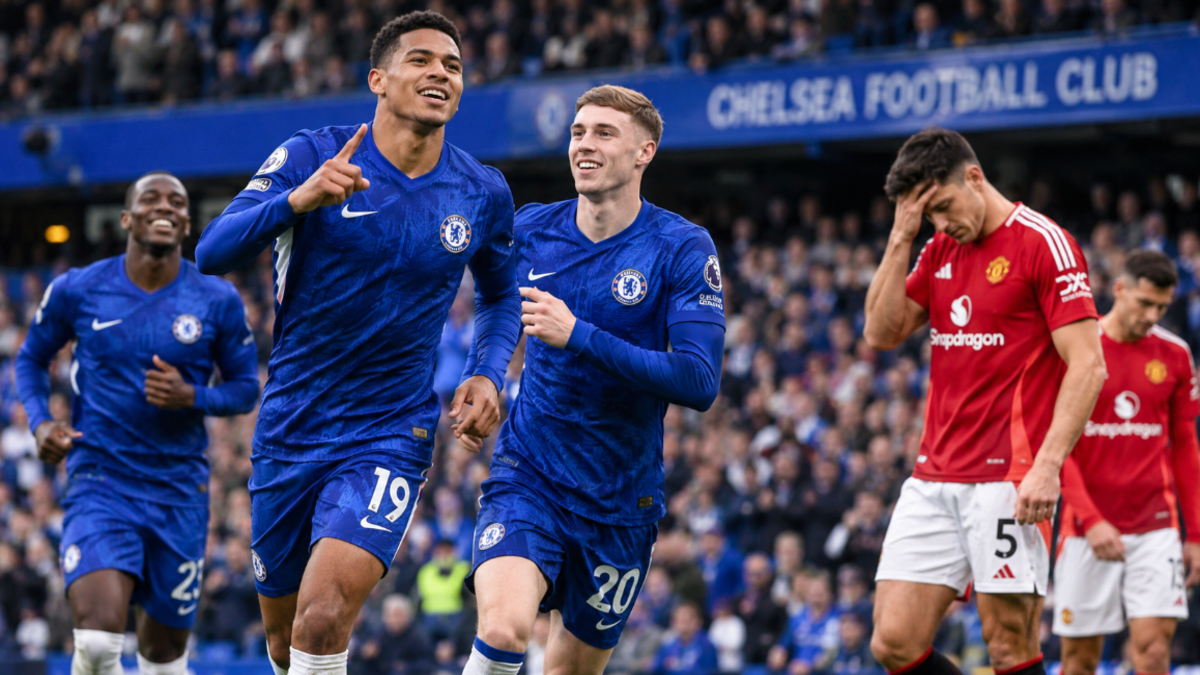
Chelsea claimed a 2–0 victory over Manchester United at Stamford Bridge on Saturday, October 31, as goals from Morgan Rogers and Cole Palmer punished the visitors after a promising first half. The result was damaging for United, whose missed chances, defensive mistakes and costly indiscipline once again raised questions about the team’s ability to perform under pressure.

Rogers broke the deadlock five minutes after half-time with an excellent individual goal. Palmer then converted a penalty after Lisandro Martínez was sent off, giving Chelsea control of a match that had looked far more competitive before the interval.
The scoreline tells only part of the story. United had opportunities to take the lead, but their failure to convert them was followed by a second-half collapse that exposed several persistent weaknesses.
Manchester United began the match with attacking intent and created opportunities that could have changed the afternoon. Bruno Fernandes and Amad Diallo both had chances, while Matheus Cunha appeared to have scored before VAR ruled the goal out for offside.
Chelsea also threatened. Estêvão Willian found the net, but that effort was disallowed for offside as well. The opening period therefore ended without a goal, despite chances at both ends.

United’s first-half performance offered some encouragement. The visitors were able to threaten Chelsea and find space in attacking areas. However, they lacked the finishing quality required to turn those openings into a lead.
That failure became increasingly significant after the break. Against a team with Chelsea’s attacking options, missed opportunities can quickly become costly.
Chelsea 1–0 Manchester United — Morgan Rogers, 50th minute
Chelsea needed only five minutes of the second half to take the lead, and the goal highlighted a major problem in United’s defensive organisation.
After Roméo Lavia recovered possession in midfield, the ball reached Rogers. The forward drove towards the penalty area, moved beyond Harry Maguire and Martínez and lifted a composed finish over goalkeeper Senne Lammens.
The quality of the finish deserves credit. Rogers showed confidence, balance and composure in a decisive moment. But United’s defending also made the opportunity possible.
The Chelsea player was allowed to advance through the middle without being stopped effectively. The defenders failed to close the space or prevent him from entering a dangerous position.
For United, this was more than an isolated defensive error. It illustrated how quickly the team’s structure could be exposed when an opponent carried the ball directly towards the penalty area.
Chelsea 2–0 Manchester United — Cole Palmer, 64th minute (penalty)
The second goal followed another damaging moment for United, this time involving Lisandro Martínez.
During a Chelsea corner, Martínez made contact with Wesley Fofana inside the penalty area. After a VAR review, referee Peter Bankes awarded Chelsea a penalty and showed the Argentine defender a second yellow card, leaving United with ten players.
Palmer stepped up and converted from the spot to make it 2–0.
The sequence was decisive. United had already fallen behind, and the dismissal made a comeback considerably more difficult. Martínez’s intervention turned a difficult situation into an even worse one for the visitors.
Palmer’s penalty also underlined Chelsea’s ability to take advantage of important moments. The midfielder remained composed and gave his side a two-goal cushion when the opportunity arrived.
The result was not simply a case of one defender making a mistake. Several aspects of United’s performance contributed to the defeat.
United created chances in the first half but failed to score. Fernandes and Diallo were among the players who could have given the visitors an advantage.
At this level, creating chances is only part of the job. Teams must convert them, particularly away from home against opponents capable of punishing mistakes. United’s inability to make their first-half pressure count left Chelsea in the game.
Rogers’ goal exposed the space available in the centre of United’s defence. The lack of an effective challenge allowed him to carry the ball into the penalty area and finish.
The problem was not just the individual quality of the goal. United needed to respond more quickly as Rogers advanced, but their defenders were unable to prevent the attack from developing.
Martínez’s dismissal was a major turning point. His second yellow card left United with ten men and came in the same sequence that produced Chelsea’s penalty.
Playing with a numerical disadvantage while trailing by two goals left United with little room to recover. The incident also highlighted the importance of discipline in high-pressure situations.
After Chelsea went ahead, the home side grew in confidence and took greater control of the match. United struggled to produce the response needed to change the momentum.
Estêvão appeared to score a third goal, but VAR ruled it out for offside. Chelsea continued to create opportunities, while United’s late effort through Bryan Mbeumo struck the crossbar after a strong intervention from goalkeeper Mike Penders.
The final score remained 2–0, but Chelsea had done enough to secure a convincing victory.
The defeat increases the pressure on Manchester United head coach Michael Carrick. According to the match coverage, United’s winless run in all competitions has reached nine games, their longest such sequence since 1988.
That statistic gives the result a wider significance. A team can lose an individual match because of missed chances or a sending-off. A prolonged run without a win, however, points to deeper problems that require a sustained response.
Carrick must find a way to improve United’s defensive reliability while making better use of the chances the team creates. The performance against Chelsea showed that attacking moments are available, but they are not enough if the side repeatedly loses control of decisive situations.
The immediate challenge is to restore confidence and consistency. Another defeat would intensify scrutiny of the manager and raise further questions about the direction of the team.
Chelsea were not flawless in the opening half. They also had a goal ruled out and faced periods in which United looked dangerous.
The difference came after the interval. Rogers produced a moment of individual quality, Palmer converted from the penalty spot, and Chelsea managed the advantage effectively.
The performance also offered encouragement to head coach Xabi Alonso. His side responded after a competitive first half and made the most of the opportunities that mattered.
For Chelsea, the victory provides three valuable Premier League points and a positive response after recent setbacks. For United, it is another reminder that promising passages of play mean little without concentration, discipline and clinical finishing.
Manchester United’s defeat at Stamford Bridge exposed a combination of problems rather than one isolated weakness. The missed chances in the first half, the space conceded to Rogers and Martínez’s dismissal all contributed to the outcome.
In our assessment, the most concerning issue is the gap between United’s ability to create opportunities and their ability to manage decisive moments. A team cannot expect to compete consistently if it wastes good chances and then compounds the problem with avoidable defensive errors.
Chelsea deserve credit for their response after half-time. Rogers supplied the breakthrough, Palmer delivered from the penalty spot, and the team took advantage of United’s mistakes.
The 2–0 result may be remembered for the goals and the red card, but its broader message is clear: Manchester United need greater discipline, better defensive coordination and more efficiency in front of goal if they are to turn their season around.
Chelsea FC — Match report: Chelsea 2-0 Manchester United — https://www.chelseafc.com/en/news/article/match-report-chelsea-2-0-manchester-united
Manchester United — Chelsea 2 Manchester United 0: Match Report — https://www.manutd.com/en/news/chelsea-2-manchester-united-0-match-report-31-oct
….Read More
Contact us at: info@sport4ever.org