Physical Address
304 North Cardinal St.
Dorchester Center, MA 02124
 Skip to content
Physical Address
304 North Cardinal St.
Dorchester Center, MA 02124

Your favorite sports world
Your favorite sports world
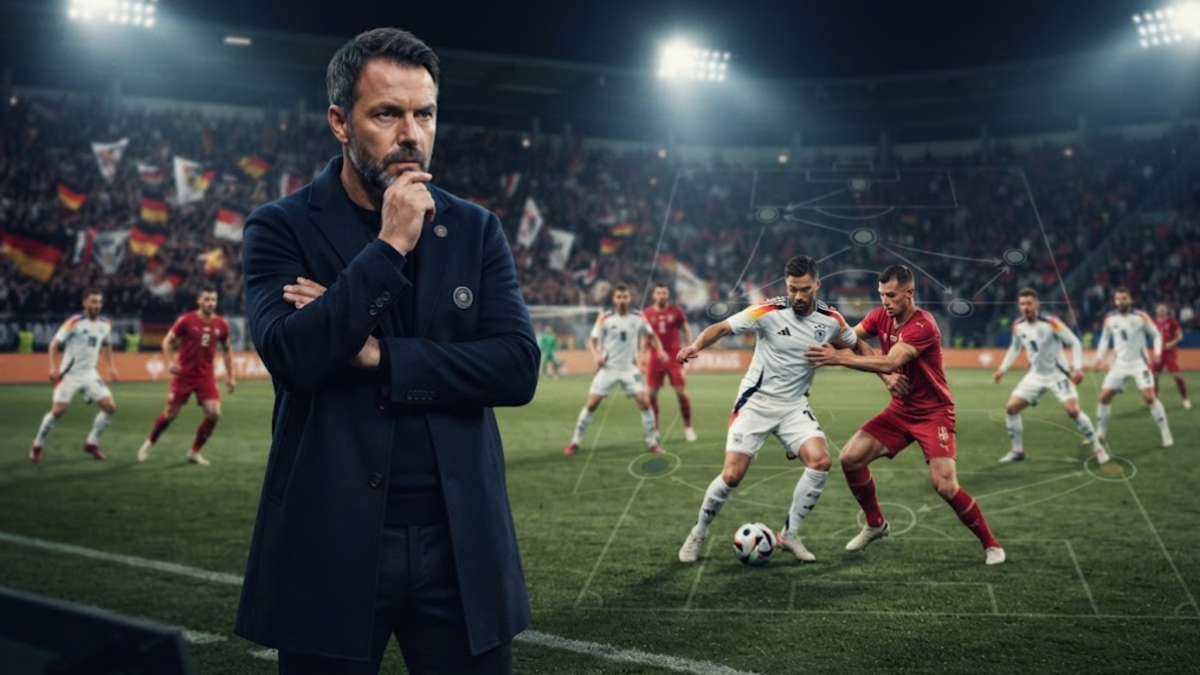
Jürgen Klopp’s Germany face Serbia in Munich with one point from their opening two Nations League matches, and the new head coach already has a clear set of problems to solve. A 1-1 draw with the Netherlands was followed by a 0-1 home defeat to Greece, leaving Germany third in Group A2 behind Greece and the Netherlands.

The Serbia match therefore matters for more than three points. It is Klopp’s first opportunity to show that the weaknesses exposed against Greece can be corrected quickly: Germany need greater precision in possession, more penetration against a deep defence, better protection after losing the ball and, above all, more efficiency in front of goal.
Klopp has also confirmed that goalkeeper Jonas Urbig will start, while Nico Schlotterbeck is unavailable after suffering an ankle injury in training.
Germany had plenty of the ball against Greece, but possession alone did not translate into goals.
The DFB’s own match report described a Greek side that defended deep, narrowed the space and waited for opportunities to counterattack. Germany struggled to find the necessary speed and precision to break through. Even when openings appeared, the final action was often missing.

That is arguably Klopp’s most immediate tactical challenge.
Against Serbia, Germany can expect another opponent comfortable with defending compactly. Klopp himself acknowledged that a deep defensive block is difficult for any team and said Germany had worked specifically on faster, safer passing.
The solution cannot simply be more possession. Germany need to make that possession more threatening.
That means quicker circulation around the Serbian block, better movement between the lines and more players attacking the penalty area when the ball reaches the wide areas.
Germany scored only once in their first two Nations League games. That goal came against the Netherlands through Felix Nmecha, while the team failed to score against Greece.
The Greece defeat showed the problem particularly clearly. Germany created several promising situations, but the finishing and final decision were inconsistent. Karim Adeyemi had opportunities, while Younes Ebnoutalib and Nmecha also came close without finding the net.
Against Serbia, Klopp needs Germany to turn territorial dominance into clear chances.
This could require a more aggressive structure around the penalty area rather than simply moving the ball from side to side. Germany need runners arriving beyond the first defensive line and enough bodies in the box to attack crosses and cutbacks.
The presence of different attacking options gives Klopp flexibility. The DFB has also indicated that both Nick Woltemade and Jonathan Burkardt are being considered as important attacking pieces, although Klopp stressed that Woltemade is not intended to be moved constantly between positions.
Klopp’s teams have traditionally been associated with aggressive pressing and rapid reactions after losing possession. With Germany, however, that mechanism is still being built.
The coach specifically identified rest defence and counter-pressing as areas that must work against Serbia.
This is crucial because Germany’s attacking structure naturally leaves space when several players push forward.
Against Greece, Germany were punished after a loss of possession created a dangerous transition before Dimitrios Kourbelis eventually put Greece ahead. The DFB report also noted that Greece had already produced a major opportunity from a German turnover before the winning goal.
The lesson is straightforward: when Germany attack with numbers, the players behind the ball must be positioned to stop the counter immediately.
If that balance is wrong, Germany can dominate a match and still give the opponent the clearest chances.
Klopp has already played down the idea that everything depends on finding a perfect double pivot.
He acknowledged that Germany’s midfield pairing cannot become perfectly synchronised after only a few days of work, but he also stressed that the whole structure has to function together.
That is an important distinction.
Germany do not necessarily need a completely new midfield against Serbia. They need clearer relationships between the midfielders, defenders and attacking players.
Joshua Kimmich remains a central part of the structure, but Germany need enough movement ahead of him to prevent the midfield from becoming a recycling station. Against a compact Serbia, midfielders must be willing to receive under pressure and immediately move the ball forward.
The objective should be to create better connections, not simply more touches.
Serbia arrive in Munich bottom of Group A2 after defeats to Greece and the Netherlands, but their results do not tell the whole story.
They lost 2-1 to Greece in their opening match and then 2-1 to the Netherlands. UEFA’s current Group A2 table has Greece on six points, the Netherlands on four, Germany on one and Serbia on zero.
Serbia’s head coach Veljko Paunović has nevertheless argued that his side improved against the Netherlands, particularly after half-time. He also described Germany as a powerful opponent and said his team had prepared for a demanding match in Munich.
Klopp has highlighted Serbia’s experience as a major danger.
That experience is concentrated in players such as Dušan Tadić, Luka Jović and other senior members of the squad. The DFB coach expects Serbia to be capable of making the game uncomfortable, particularly if Germany become impatient.
Germany therefore need to avoid turning the match into a frantic contest.
Nico Schlotterbeck will miss the match after twisting his ankle during a warm-up without contact. Klopp confirmed that Schlotterbeck is definitely unavailable for the Serbia game.
His absence matters because Germany are still developing their defensive relationships under a new coach.
The replacement must not simply defend well; he must also contribute to the first phase of possession and help Germany maintain pressure after losing the ball.
That makes defensive organisation particularly important. Serbia have enough experience in attack to punish a German team that becomes stretched.
Jonas Urbig will make his Germany debut against Serbia. Klopp confirmed the decision before the match, and Urbig said he had learned of the selection during training.
The goalkeeper should not be viewed as the solution to Germany’s broader problems, but his introduction adds another element to an already changing team.
For Urbig, the priority should be simple: communicate clearly, make the routine saves and remain comfortable when Germany build from the back.
A goalkeeper making his debut needs a defence that does not expose him unnecessarily. That puts even more responsibility on Germany’s rest defence and pressing structure.
| Area | Problem exposed against Greece | What Klopp needs |
|---|---|---|
| Chance creation | Plenty of possession but limited penetration | Faster combinations and more movement |
| Finishing | Opportunities were not converted | Greater quality in the final action |
| Counter-pressing | Serbia can exploit transitions | Immediate pressure after losing possession |
| Rest defence | Germany were vulnerable to turnovers | Better protection behind the attack |
| Midfield | Structure is still developing | Clearer connections between the lines |
| Defence | Schlotterbeck is unavailable | Stability despite personnel changes |
| Goalkeeper | Urbig makes his debut | Simple, confident performance |
Germany’s position makes the Serbia match significant. With only one point from two games, another poor result would leave Klopp’s side with considerable ground to recover in Group A2.
But judging the new Germany coach after two competitive matches would be premature.
Klopp was appointed on a four-year contract and is tasked with leading Germany through UEFA EURO 2028 and the 2030 FIFA World Cup. The DFB has explicitly framed the appointment as the beginning of a rebuilding process, with Klopp himself calling for patience.
The more useful question, then, is not whether Germany suddenly look finished under Klopp. They clearly do not.
The question is whether the team can show visible progress from one match to the next.
Against Serbia, that progress should be visible in three areas: faster attacking combinations, better protection against counterattacks and greater efficiency around the penalty area.
From our perspective, Klopp does not need to reinvent Germany after two matches. He needs to make the existing pieces work together more effectively.
The defeat to Greece exposed a familiar international-football problem: Germany could control territory without controlling the decisive moments. Against Serbia, Klopp needs to reduce the gap between possession and genuine danger.
His own comments suggest that he understands the issue. He has specifically identified rest defence, counter-pressing and quicker passing as priorities.
The biggest test will be Germany’s patience. If Serbia sit deep, Klopp’s side cannot become predictable or overcommit. If Germany can circulate the ball quickly, attack the spaces around the Serbian defensive block and react immediately when possession is lost, the foundations of Klopp’s project will begin to look much clearer.
The Serbia game is not a final verdict on Klopp’s Germany. It is an early test of whether the lessons from the Greece defeat have actually been absorbed.
The Munich meeting is the first of two scheduled encounters between the teams in the Nations League. Germany are due to travel to Belgrade for the return fixture in November. UEFA’s fixture list also has Germany facing Greece away immediately after the Munich match.
That makes the current international window especially important. Klopp has four Nations League matches in the opening phase of his tenure, giving him limited time but several competitive opportunities to establish his preferred structure.
The immediate target against Serbia is therefore clear: win the match, but do so with a performance that demonstrates tactical progress.
The main issues are Germany’s attacking efficiency, their ability to break down a deep defence, their counter-pressing and their defensive structure after losing possession.
Not yet. Germany drew 1-1 with the Netherlands and then lost 0-1 to Greece in Klopp’s first two competitive matches.
Jonas Urbig has been confirmed by Klopp as the starter for the Serbia match. It will be his Germany debut.
Schlotterbeck suffered an ankle injury during a warm-up and was ruled out of the Serbia match by Klopp.
Before the Germany-Serbia match, Greece lead Group A2 with six points, the Netherlands have four, Germany have one and Serbia have none.
….Read More
Contact us at: info@sport4ever.org