Physical Address
304 North Cardinal St.
Dorchester Center, MA 02124
 Skip to content
Physical Address
304 North Cardinal St.
Dorchester Center, MA 02124
Your favorite sports world
Your favorite sports world
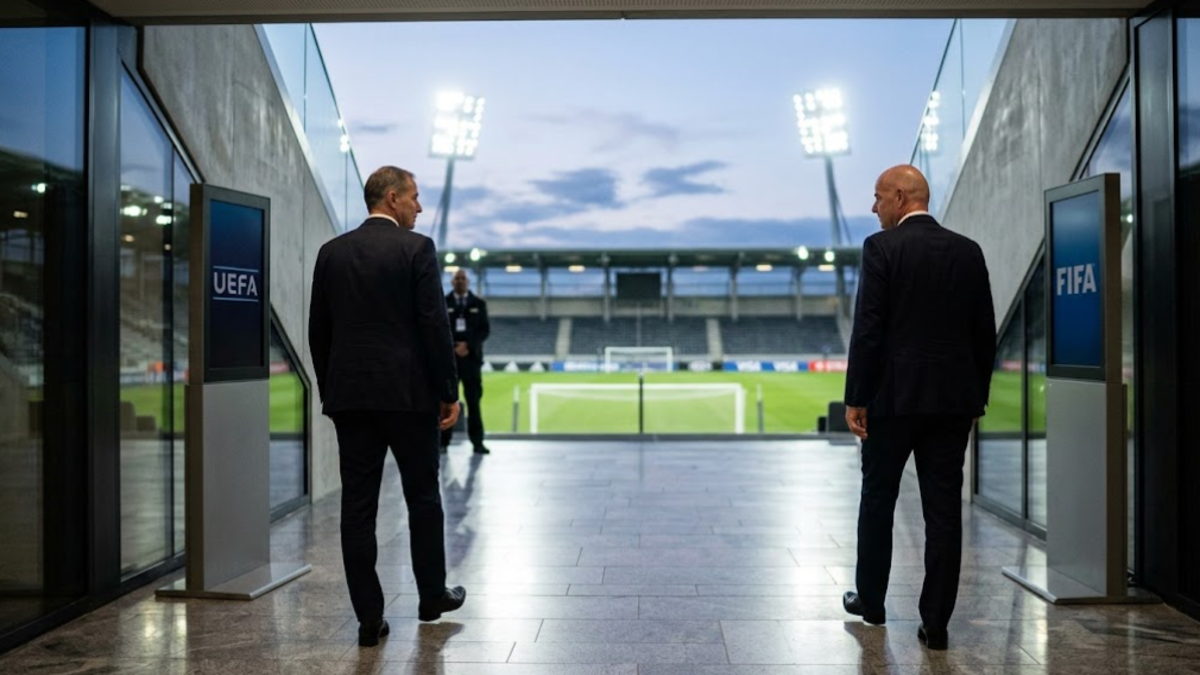
European football’s governing body, UEFA, has intensified pressure on FIFA President Gianni Infantino by seeking detailed explanations about his leadership, a controversial World Cup investment proposal and questions surrounding FIFA’s governance. According to reports published on October 19 and 20, 2026, UEFA has submitted 42 questions across 12 topics and wants substantive written answers by November 2.

The dispute comes as Infantino prepares for a FIFA presidential election expected in March 2027. With confidence in his leadership under scrutiny among some European football officials, the confrontation could become a significant test of transparency and accountability at the top of world football.

The latest move follows growing dissatisfaction among European football leaders over decisions taken under Infantino’s presidency. UEFA Secretary General Theodore Theodoridis reportedly sent a letter to FIFA Secretary General Mattias Grafström requesting answers to a wide range of questions.
The reported letter covers 12 subjects, including the abandoned FIFA Forward Enterprise (FFE) proposal, potential conflicts of interest, FIFA’s relationship with US President Donald Trump and the organisation’s handling of several controversial decisions.

According to Reuters, which reported on the demand while noting that it had not independently seen the letter, UEFA wants answers before FIFA’s next council meeting in December rather than waiting for further discussions. UEFA and FIFA had not publicly commented on the reported letter at the time of publication.
The distinction matters: the questions reflect concerns raised by UEFA, not proof that misconduct occurred. Their significance lies in the demand for documentation and explanations from an organisation responsible for governing football worldwide.
The FIFA Forward Enterprise project has become the main flashpoint in the relationship between the two organisations.
In July, FIFA presented FFE as a proposed subsidiary intended to consolidate the commercial and event operations of FIFA competitions. Infantino argued that the structure could increase the commercial value of those competitions and generate additional funding for football development around the world.
FIFA said the proposal would remain subject to consultation and approval by its member associations and the FIFA Council. The organisation presented potential benefits including more investment in facilities, national teams, youth development and women’s football.

However, the proposal triggered opposition and concerns over the way it had been developed and communicated. On July 31, FIFA announced that the project would not proceed, saying that the divisions it had created were no longer consistent with its original objective.
At a FIFA Council meeting on October 15, Infantino apologised for mistakes in the handling and communication of the proposal. FIFA also said that externally appointed lawyers had briefed the council on the legal background, while details remained confidential because of ongoing legal proceedings in the United States.
For UEFA, the withdrawal of FFE has not ended the matter. Its reported demand for answers suggests that European officials want a clearer account of how the proposal was developed, what decisions were taken and how FIFA’s internal oversight operated.
The 42 questions reportedly cover several areas of FIFA’s leadership and decision-making. These include:
The FFE project: how the proposal was developed, who was involved and why it was not brought through the expected governance processes earlier.
Potential conflicts of interest: questions concerning business and political relationships involving Infantino, Trump and people associated with the US president.
The FIFA Peace Prize: scrutiny of the award presented to Trump during the 2026 World Cup final draw in Washington.
Disciplinary decisions: questions surrounding the suspension of the one-match ban imposed on US forward Folarin Balogun following his sending-off against Bosnia and Herzegovina at the 2026 World Cup.
Institutional independence: concerns about transparency, accountability and the independence of FIFA’s governance and oversight structures.
These topics have been described in reporting on the letter and in UEFA’s wider campaign for FIFA reform. They should be understood as matters requiring clarification, not established findings of wrongdoing.
The FIFA Peace Prize is also a separate issue from the abandoned FFE proposal. FIFA introduced the award in 2025 and presented its inaugural prize to Trump in December of that year. UEFA’s reported questions reflect wider scrutiny of Infantino’s leadership and public relationships.
FIFA has acknowledged mistakes in the handling of the FFE initiative and confirmed that the proposal has been permanently withdrawn. Following the October council meeting, it also announced a working group to examine possible governance reforms.
In addition, FIFA said its relevant standing committee would assess the Peace Prize, with a decision expected at the council’s next meeting in December. The organisation also announced a review of disciplinary procedures following the Balogun case.
These steps indicate that some of the issues raised are already under review within FIFA. However, they do not amount to a complete response to UEFA’s reported list of questions, nor do they establish that the concerns have been resolved.
According to the reports published on October 19 and 20, UEFA wants written answers and supporting information by November 2. FIFA had not publicly responded to the reported letter at the time those reports were published.
The next significant dates are therefore:
| Date | Significance |
|---|---|
| November 2, 2026 | Reported deadline for FIFA’s substantive response to UEFA |
| November 18, 2026 | Reported deadline for FIFA presidential nominations |
| December 2026 | Next FIFA Council meeting, where further governance matters are expected to be considered |
| March 2027 | Expected FIFA presidential election |
The nomination deadline and election timetable make the dispute more consequential than a routine disagreement between football administrators. The timing gives UEFA an opportunity to press for answers before the presidential contest advances further.
Infantino announced in May that he intended to seek re-election in 2027. He has led FIFA since 2016, when he succeeded Sepp Blatter.
The challenge for UEFA is not simply to obtain explanations about a withdrawn commercial project. It is also to determine whether FIFA’s current governance arrangements provide sufficient transparency and accountability when major decisions are made.
On October 8, UEFA announced that its 55 national associations had lost confidence in FIFA’s current leadership and called for new leadership alongside institutional reforms. The statement established that dissatisfaction extended beyond a single controversy.
However, UEFA does not independently appoint the FIFA president. The election is determined through FIFA’s member-association voting process. Any challenge to Infantino would therefore require sufficient support from football associations beyond Europe.
The dispute could influence how national associations assess the candidates, governance proposals and future direction of the organisation. It does not, by itself, determine the election result.
FIFA’s leadership now faces a credibility challenge. With the FFE proposal withdrawn and an internal governance review under way, the organisation has acknowledged that the way the project was handled required improvement.
The key question is whether these measures will produce meaningful accountability. A new working group can recommend reforms, but confidence also depends on whether decision-making processes become clearer and whether legitimate questions receive substantive answers.
UEFA’s approach is significant because it seeks written explanations and documentation rather than relying solely on assurances about future reform. At the same time, FIFA must be given an opportunity to respond, and allegations of conflicts of interest should not be treated as proven without supporting evidence.
For football supporters, the immediate consequences may not be visible on the pitch. The longer-term implications are more important: how commercial revenues are managed, how development funding is distributed and whether the sport’s governing institutions can demonstrate that their decisions serve football as a whole.
The November deadline is an important next milestone. What follows will help determine whether the disagreement leads to credible governance improvements or deepens the divisions ahead of the 2027 presidential election.
UEFA is seeking explanations about Gianni Infantino’s leadership, the abandoned FIFA Forward Enterprise project and wider governance concerns. Reports say its letter contains 42 questions across 12 topics.
FFE was a proposed FIFA subsidiary intended to consolidate commercial and event operations. FIFA argued that it could increase revenue and funding for football development, but the proposal was withdrawn on July 31, 2026.
The reported questions and allegations do not establish wrongdoing. They concern matters that UEFA wants FIFA to explain and document. Any conclusions should be based on verified evidence and the relevant review processes.
Reports published on October 19 and 20 state that UEFA set a deadline of November 2, 2026, for substantive written answers and supporting documents. FIFA had not publicly responded to the reported letter when those reports appeared.
It could influence how football associations assess his leadership, but the outcome is not predetermined. Infantino has announced his intention to seek re-election in March 2027, and the result will depend on the voting process and support among FIFA’s member associations.
1. FIFA — FIFA President tells Member Associations new subsidiary would be a ‘golden opportunity’ to increase football development — Read the official FIFA statement
2. FIFA — Statement attributable to the FIFA President: FIFA Forward Enterprise proposal will not proceed — Read the official FIFA statement
3. FIFA — FIFA President calls for unity at Council meeting and stresses commitment to serving FIFA Member Associations — Read the official FIFA Council report
4. FIFA — President Donald J. Trump awarded “FIFA Peace Prize – Football Unites the World” — Read the official FIFA announcement
5. UEFA — Aleksander Čeferin accepts unanimous request from Europe’s 55 national associations to seek final term as UEFA President — Read the official UEFA statement
6. FIFA — Gianni Infantino announces intention to stand for re-election in 2027 — Read the official FIFA announcement