Physical Address
304 North Cardinal St.
Dorchester Center, MA 02124
 Skip to content
Physical Address
304 North Cardinal St.
Dorchester Center, MA 02124

Your favorite sports world
Your favorite sports world
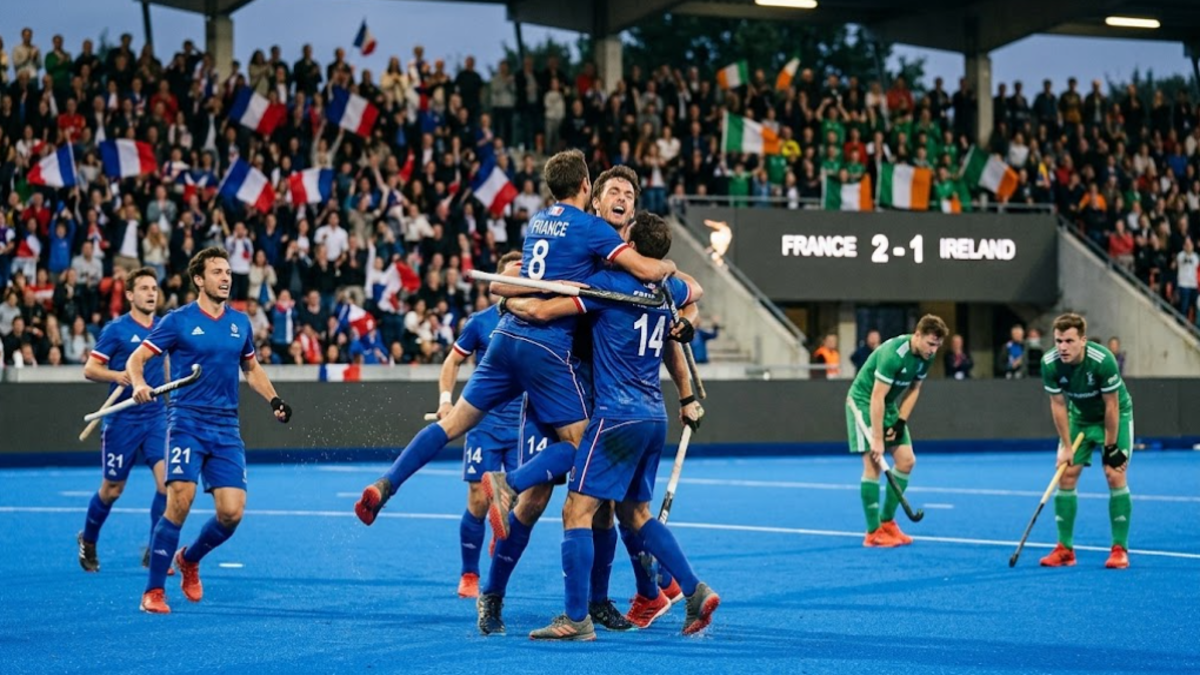
PARIS – Sport 4 ever: France defeats Ireland 2–1 at the Hockey World Cup

France defeats Ireland 2–1 at the Hockey World Cup in a dramatic Pool H finale in Wavre, Belgium, with France scoring the decisive goal in the final two minutes after Ireland had taken the lead through Jeremy Duncan. The result gave France a much-needed victory, while Ireland still secured first place in the pool after earlier wins over South Africa and Malaysia. With both teams already knowing their broader tournament positions were taking shape, why did this final meeting still produce such a tense contest?
France completed its Pool H campaign with a 2–1 victory over Ireland at the Belfius Hockey Arena in Wavre on Sunday, August 23, turning the match around after falling behind early in the second half.
Ireland entered the contest knowing that it had already done enough to finish at the top of Pool H. Wins over South Africa and Malaysia had given the Irish side the points it needed, while results elsewhere confirmed that first-place finish.
That meant the match did not carry the same qualification pressure for Ireland as it did for France. Nevertheless, the meeting carried considerable importance for both teams, particularly because of the growing rivalry between the two sides.

The first half offered little between them. Both teams looked cautious and disciplined, attempting to identify weaknesses without exposing themselves unnecessarily.
Chances remained limited, and neither goalkeeper faced sustained pressure during the opening period. The two sides went into the interval level, with neither able to find the breakthrough.
The contest changed shortly after the restart.
Ireland produced the first major moment when Jeremy Duncan intercepted the ball from Eliot Curty. Duncan then moved around the French goalkeeper before finishing with his reverse stick from a tight angle.
His effort found the bottom corner and gave Ireland a 1–0 advantage.
The goal immediately changed the atmosphere of the match. France now needed to respond, and the French side increased its pressure around the Irish circle.
Only three minutes after Duncan’s opener, France won a penalty corner.
Victor Charlet stepped forward and produced the response France needed, firing powerfully into the bottom corner to restore parity.
The score became 1–1, setting up a final quarter in which France continued to push for the victory.
The equaliser gave France renewed momentum, and the French side began finding more routes into Ireland’s circle.
Ireland’s defence, however, remained organised. The Irish players repeatedly dealt with French attacks and prevented their opponents from turning territorial pressure into a second goal.
The tactical situation became even more interesting as the match entered its decisive stages.
France needed a victory and eventually took a greater risk by removing goalkeeper Corentin Saunier and replacing him with an additional outfield player.
The move gave France an extra attacking option and allowed the team to apply further pressure around the Irish circle.
That gamble almost produced the decisive moment through a penalty corner.
France won the set piece, but Ireland goalkeeper Jaime Carr reacted quickly and parried the effort over the bar.
Ireland appeared to have survived another dangerous period.
Yet France continued searching for the winning goal.
With only two minutes remaining, the French attack finally broke through again.
Timothée Clément produced the decisive touch in front of Carr, deflecting the ball into the Irish net and putting France ahead 2–1.
The late goal completed France’s comeback and left Ireland with too little time to respond.
France therefore closed the contest with a narrow victory, while Ireland had to settle for defeat despite maintaining first place in Pool H.
The result also highlighted the fine margins between the two teams. Ireland had led after Duncan’s goal, France had responded almost immediately, and the winning goal arrived only in the final stages.
For France, the victory provided a positive finish to its Pool H campaign after the team had entered the classification phase needing results to improve its final tournament position.
For Ireland, the defeat did not alter its position at the top of the pool.
Jeremy Duncan played a central role in Ireland’s strongest spell of the match.
His opening goal came from an individual piece of play rather than a conventional penalty-corner situation. Duncan read the opportunity, won possession from Curty and then created enough space to finish despite the difficult angle.
The reverse-stick finish gave Ireland a deserved advantage after a first half in which both sides had struggled to create clear opportunities.
The goal was also significant because France had been the team attempting to control more of the attacking initiative as the match developed.
Ireland’s lead demonstrated the value of staying compact and waiting for opportunities rather than forcing the game.
After the goal, however, France responded almost immediately.
That quick reaction prevented Ireland from building a larger advantage and shifted momentum back towards the French side.
Duncan later reflected on the narrow margin between the teams, saying Ireland would have preferred to hold the 1–1 score or find a second goal itself.
His comments captured the character of the contest: there was very little separating the sides, and the final outcome depended on a late attacking moment.
The Irish midfielder also emphasised the significance of the team’s first-place finish in Pool H.
Ireland had entered the tournament with the objective of reaching the classification match that would allow it to challenge for a high final ranking if a place among the top eight proved out of reach.
That objective was achieved.
Duncan said the team was delighted to reach the ninth/tenth-place play-off and wanted to finish the tournament as the ninth-ranked side.
Victor Charlet provided France’s crucial response when the French side needed it most.
Ireland’s opening goal could have created a difficult situation for France, particularly because the Irish defence had already demonstrated its ability to frustrate attacking moves.
Instead, France quickly earned a penalty corner and used it to restore the balance.
Charlet’s powerful effort into the bottom corner made it 1–1 only three minutes after Duncan’s goal.
The equaliser prevented Ireland from settling into a defensive approach built around protecting a lead.
It also encouraged France to continue attacking rather than accepting a draw.
That became increasingly important as the final quarter progressed.
France repeatedly entered the Irish circle and looked for opportunities to create a second goal. Ireland remained disciplined, but the sustained pressure eventually forced the French coaching staff to take an additional risk.
The decision to remove goalkeeper Saunier for an extra outfield player showed the importance France placed on securing the win.
The move could have left France vulnerable to a counterattack, but Ireland was unable to exploit the numerical change.
Instead, France used the extra attacking player to generate another penalty corner.
Carr’s intervention temporarily kept Ireland level, but France’s pressure continued until Clément produced the decisive deflection.
The sequence showed how France gradually increased the pressure rather than relying on one isolated chance.
The French side first responded to the setback, then controlled more of the attacking territory, then increased the risk in search of the winning goal.
That approach ultimately paid off.
Although Ireland lost the match, the result did not prevent the team from finishing first in Pool H.
Its earlier victories over South Africa and Malaysia had already placed Ireland in a strong position.
Results elsewhere then confirmed that Ireland had accumulated enough points to remain at the top.
That achievement carries particular significance for Irish men’s hockey because it guarantees the team’s best-ever finish at a Hockey World Cup.
Ireland’s next assignment will be the ninth/tenth-place play-off in Wavre on Friday, August 28.
The opponent will come from the meeting between Pakistan and New Zealand.
The match will determine Ireland’s final position in the tournament and give the team an opportunity to finish ninth.
Ireland’s campaign has therefore moved beyond the immediate disappointment of losing to France.
The team can still finish the tournament with a notable ranking and has already secured a historic position.
The contrast between the result and the wider situation is important.
France won the match, but Ireland won the battle for first place in the pool.
That makes the 2–1 scoreline more complicated than a simple victory-and-defeat narrative.
For France, the result provides momentum and a chance to finish the classification phase strongly.
For Ireland, the loss is frustrating, but it does not erase the progress made earlier in the tournament.
The two teams now move towards their respective final classification matches with different objectives.
France can take confidence from overturning a deficit against an opponent that had already secured top spot.
Ireland, meanwhile, can focus on the opportunity to secure ninth place and complete one of its strongest World Cup campaigns.
The latest France-Ireland meeting once again demonstrated how closely matched the teams have become.
Their recent encounters have produced competitive games, and the World Cup meeting in Wavre followed that pattern.
The first half ended without a goal. Ireland then struck first through Duncan, France answered through Charlet, and Clément settled the contest near the end.
That sequence left no room for complacency.
France needed patience after conceding, while Ireland needed to maintain its defensive organisation after the equaliser.
The decisive difference came in the final minutes.
France’s willingness to commit an additional outfield player showed the team’s determination to take the initiative rather than wait for a draw.
Ireland defended the resulting pressure effectively for long periods, but one final deflection proved enough to change the result.
For Clément, the late goal delivered a memorable finish.
For Charlet, the equaliser was the platform for the comeback.
For Duncan, the opening goal represented Ireland’s best moment in a match that ultimately slipped away.
And for Carr, the Irish goalkeeper, the late defeat came despite an important intervention that had temporarily denied France from another penalty corner.
The match therefore offered a compact illustration of international hockey at its most competitive: limited chances early, a sudden breakthrough, a rapid response and a late winner.
The official FIH Hockey World Cup information provides the tournament’s official competition and match information.
France’s 2–1 victory gives the team an important boost after the opening stage of the classification competition.
The French side showed resilience by recovering from a goal down and continuing to attack when a draw would have been the easier outcome.
The late winner also demonstrated the value of taking calculated risks when a victory is required.
Ireland’s situation is different.
The team can be disappointed by the loss, but its first-place finish in Pool H remains intact.
The Irish side now has a clear target: win the ninth/tenth-place play-off and complete the tournament in ninth position.
That ambition was reflected in Duncan’s comments after the match.
He stressed that the squad wants to finish ninth and views the upcoming play-off as an opportunity to confirm its standing.
The result against France therefore closes one chapter rather than ending Ireland’s tournament.
For France, meanwhile, the victory provides evidence that the side can respond under pressure.
Going behind did not cause the French attack to lose structure. Instead, the team increased its pressure, found an equaliser and continued looking for the winner.
The final two minutes ultimately decided everything.
France defeats Ireland 2–1 at the Hockey World Cup, but the scoreline tells only part of the story.
Ireland still leaves the pool stage as the leader, while France leaves Wavre with the confidence that comes from a comeback victory against a strong opponent.
Both teams now have one final ranking objective ahead of them.
And after such a tight contest, the next matches will determine whether France can build on this late victory and whether Ireland can turn its historic pool finish into a ninth-place overall result.
France defeated Ireland 2–1 in Wavre, Belgium.
Jeremy Duncan scored Ireland’s only goal.
Timothée Clément scored the decisive late goal for France.
Yes. Ireland remained top of Pool H despite the 2–1 defeat to France.