Physical Address
304 North Cardinal St.
Dorchester Center, MA 02124
 Skip to content
Physical Address
304 North Cardinal St.
Dorchester Center, MA 02124

Your favorite sports world
Your favorite sports world
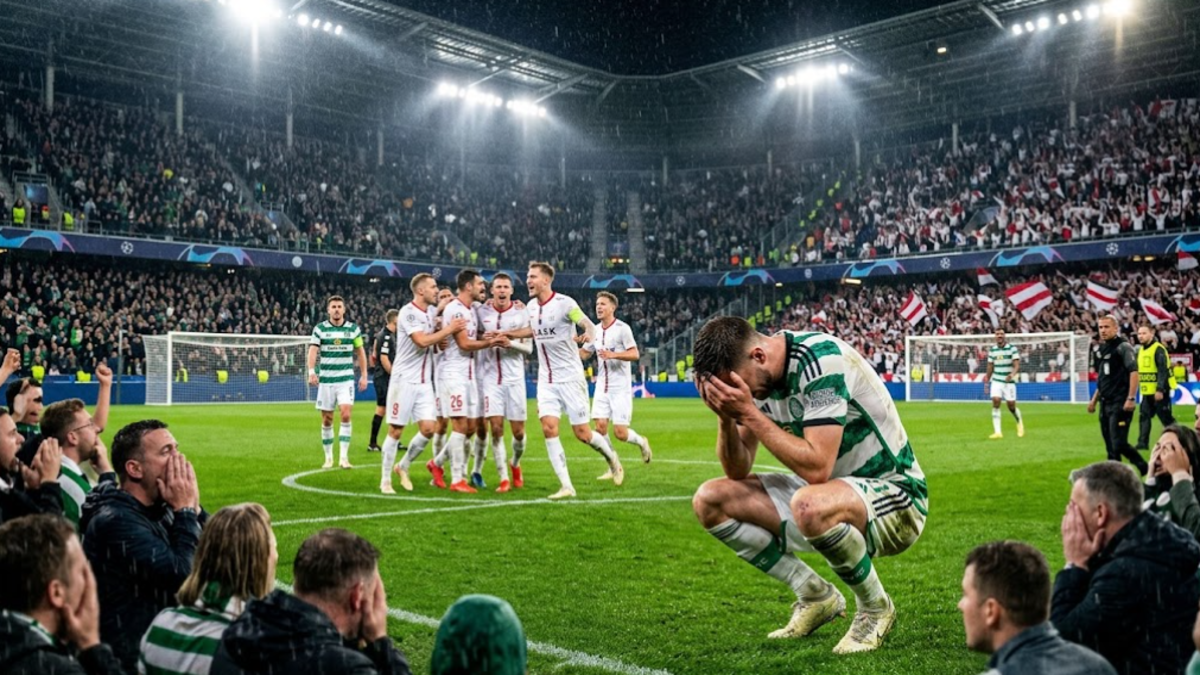
VIENNA – Sports 4 ever: Celtic Champions League collapse stunned European football as LASK overturned a four-goal aggregate deficit to beat Celtic 5-1 after extra time, completing a 5-4 victory in a dramatic Champions League play-off second leg. The Scottish champions appeared to have the tie under control after Callum McGregor extended their first-leg advantage, but a remarkable fightback from the Austrian side transformed the match and ended Celtic’s hopes of reaching the league phase. How did Celtic allow such a commanding lead to disappear?

Celtic travelled to Austria carrying a 3-0 lead from the opening leg and quickly strengthened their position at the Raiffeisen Arena. McGregor struck in the 21st minute with a low effort that took a deflection before flying beyond the LASK goalkeeper, giving Martin O’Neill’s team a four-goal advantage on aggregate.
At that stage, Celtic needed only to protect an apparently unassailable position. Instead, the night developed into one of the most dramatic collapses in the club’s recent European history.
The warning signs had already appeared before Celtic opened the scoring. LASK created dangerous moments inside the opening half, including an effort that struck the post, while Celtic had opportunities of their own but failed to establish control.
Mika Baur came close after six minutes when he reached a dangerous ball in the area but poked his attempt wide with Hogh closing in. LASK then threatened at the other end as Mbuyamba failed to make clean contact with a chance in the box before another effort hit the post.

McGregor’s goal temporarily shifted the pressure back onto the hosts. Celtic had the lead in the match and a four-goal cushion in the tie, but their advantage did not last.
The turning point arrived shortly before the interval. Celtic surrendered possession in a dangerous area, allowing Moses Usor to collect the loose ball and finish past Viljami Sinisalo. That goal did more than halve LASK’s deficit on the night. It gave the Austrian champions belief.
Celtic reached half-time still three goals ahead on aggregate, but the psychological balance had changed. LASK now had evidence that the visitors could be exposed, and the home side returned for the second half with far greater intensity.
That shift became decisive almost immediately.
Robert Ljubičić levelled the match on the night with a superb low strike from the edge of the area in the 48th minute. Celtic’s once comfortable advantage had suddenly been cut to two goals on aggregate, and LASK sensed an extraordinary opportunity.
Samuel Adeniran then produced one of the standout moments of the contest. His curling finish from distance in the 58th minute left Sinisalo with no realistic chance and reduced Celtic’s aggregate lead to a single goal.
The atmosphere around the ground changed completely.
Celtic needed to survive the final stages of normal time, but LASK continued to attack with the energy of a team that believed the impossible was within reach.
O’Neill’s side had appeared to weather the storm on several occasions, only to concede another decisive blow deep into the game.
In the 90th minute, LASK finally completed the comeback in normal time. Sinisalo initially denied Joao Victor Tornich, but Celtic failed to clear the danger and Florian Flecker headed in the rebound.
The goal made it 4-4 on aggregate and forced extra time.
For Celtic, the objective had changed from managing a comfortable lead to simply finding a route out of a match that had spiralled beyond control. LASK, meanwhile, had spent the closing stages of the second half dictating the momentum.
Extra time followed the same pattern.
LASK continued to push forward while Celtic struggled to recover the authority they had shown at the start of the contest. Adeniran then delivered the decisive strike in the 109th minute, beating Sinisalo from range again and sending LASK ahead on aggregate for the first time.
Celtic still had a chance to save themselves.
Instead, another major moment went against them when Reo Hatate brought down Krystof Danek inside the area in the 114th minute. LASK had the chance to settle the tie from the penalty spot and complete an even more emphatic victory.
Sinisalo, however, produced a crucial save to deny the penalty.
It briefly kept Celtic alive, but LASK held on to complete a 5-1 victory on the night and a 5-4 aggregate triumph.
For the Austrian side, the result represented a dramatic route into the Champions League league phase. For Celtic, it meant another season in which the club failed to negotiate the final hurdle of qualifying.
UEFA confirmed that LASK advanced after completing the comeback, while Celtic dropped into the Europa League league phase. The result also marked LASK’s first victory in their last 12 UEFA competition matches, a remarkable statistic given the magnitude of the occasion.
The scoreline alone does not fully capture how unexpected the result was.
Celtic entered the match three goals ahead from the first leg and increased that advantage to four before the hosts had even found their rhythm. Yet the Scottish side allowed LASK to score twice either side of half-time, then failed to stop the hosts when the pressure reached its peak.
Celtic’s inability to regain control after Ljubičić’s goal proved especially costly.
Once Adeniran made it 3-1 on the night, every LASK attack carried greater significance. Celtic needed to break the rhythm, slow the game down and defend their aggregate advantage. Instead, they allowed the hosts to maintain the intensity that had transformed the contest.
The final statistics of the collapse mattered less than the sequence of events. Celtic had everything in their favour and then watched each layer of protection disappear.
O’Neill cut a frustrated figure after the defeat and accepted that Celtic had failed to manage the game once LASK gained momentum.
The Celtic manager argued that his team should have been further ahead before the interval after creating strong opportunities. He also acknowledged that conceding just before half-time handed LASK a route back into the tie.
O’Neill described the defeat as a massive disappointment and accepted that responsibility rested with him and his team.
His assessment focused on Celtic’s inability to cope with the momentum shift. From his perspective, the visitors remained in command at half-time despite the first LASK goal, but the early second-half strike changed the match.
Once LASK began to chase the aggregate deficit aggressively, Celtic struggled to escape sustained pressure.
O’Neill also made clear that the Europa League offered little immediate comfort. Celtic had entered the tie aiming for Champions League qualification, and the manner of the defeat made the eventual destination feel even more painful.
The manager’s comments reflected the wider sense of frustration surrounding the result. Celtic had not simply lost a close qualification battle. They had surrendered a lead that appeared almost impossible to overturn.
McGregor’s role in the match captured both sides of Celtic’s night.
He scored the opening goal and briefly placed his team in an even stronger position, but he later stood among the players visibly affected by the collapse.
After the final whistle, the Celtic captain offered a blunt assessment. He said the team had played too passively and suggested they looked reluctant to take control of the match.
McGregor also admitted that Celtic had not been especially impressive in the first leg despite winning 3-0.
That admission added another layer to the post-match debate.
The aggregate score had created the appearance of a commanding Celtic performance across two legs, but McGregor’s comments suggested the margin had masked underlying problems. Once LASK found an attacking rhythm, Celtic could not restore the control their lead demanded.
The captain also apologised to the supporters and the club, insisting that Celtic had no excuse for losing a match from such a strong position.
His message was clear: the players now have to show what kind of character they possess after suffering a defeat that could have lasting consequences.
For a club that expects to compete regularly on the European stage, that challenge will extend beyond one difficult evening.
Celtic’s defeat also carries the weight of what happened last season.
The Scottish champions were eliminated at the same stage by Kairat Almaty after a penalty shoot-out. This time, there was no shoot-out and no narrow margin. Celtic lost by four goals on the night and surrendered a four-goal aggregate advantage.
That difference will make the latest disappointment particularly difficult for supporters to accept.
The previous elimination already raised questions about Celtic’s ability to navigate Champions League qualifying pressure. The LASK defeat intensifies those concerns because the club had placed itself in an even stronger position before collapsing.
The expectation around Celtic remains significant, and European qualification carries sporting and financial consequences that extend beyond one fixture.
The sporting disappointment also carries a major financial dimension.
Sky Sports News estimated that a place in the Champions League league phase could have been worth around £40 million to Celtic when combining different sources of revenue linked to qualification.
That figure included an estimated UEFA value component of roughly £14 million to £16 million and at least £16 million associated with automatic league-phase qualification, according to the analysis cited in the supplied reporting.
There was also the possibility of additional matchday income from four home fixtures, with an estimate of up to another £10 million if Celtic sold out every match.
Those numbers help explain why the defeat matters so much beyond the football itself.
Celtic had already invested heavily in the squad, with the supplied financial assessment putting spending at around £30 million. The failure to reach the Champions League therefore creates an immediate question over how the club approaches recruitment and squad building from this point.
The financial difference between Europe’s two major competitions can shape a club’s ambitions, particularly when a team has planned spending around the expectation of entering the Champions League.
The full financial impact will depend on a range of commercial, broadcast and matchday factors, but there is no doubt that Celtic have lost a potentially substantial revenue opportunity.
The reaction from Celtic supporters reflected the scale of the disappointment.
Messages circulated after the match described the performance as humiliating and questioned whether Celtic were equipped to compete effectively in European competition.
Some supporters compared the result unfavourably with last season’s elimination by Kairat, arguing that losing from a four-goal aggregate position represented an even more painful failure.
Others highlighted tactical decisions and substitutions, while some questioned whether the team had shown enough urgency once LASK began to build pressure.
The most common theme was not simply anger at the defeat. It was disbelief at how Celtic had reached the final whistle in that position.
A three-goal first-leg lead should have provided security. McGregor’s opening goal should have made the task even easier. Instead, Celtic watched LASK score five times and produce one of the most dramatic comebacks in the club competition.
That contrast explains the intensity of the reaction.
For LASK, the victory will become a defining European memory. The Austrian club recovered from a four-goal deficit and reached the Champions League league phase after a night in which virtually every major momentum swing went in its favour.
For Celtic, the same match will be remembered as a warning about how quickly a European tie can change when a team loses control.
Celtic will continue their European campaign in the Europa League after failing to reach the Champions League league phase.
The Europa League league-phase draw is scheduled for Friday, with the ceremony taking place in Monaco. The competition then offers Celtic another opportunity to test themselves against teams from across Europe.
That route still gives Celtic a substantial European programme, but it is not the destination the club expected when it travelled to Austria with a 3-0 advantage.
The immediate priority will be recovering mentally from a defeat that few inside the club could have anticipated.
O’Neill now faces questions about how Celtic rebuild confidence, how the squad responds and whether the club changes its plans following the loss of Champions League revenue.
The players will also have to respond.
McGregor’s post-match comments placed responsibility firmly on the squad, and that challenge now becomes part of Celtic’s season. European disappointment can either damage a campaign or become the point at which a team changes its mentality.
Celtic have already experienced both ends of that spectrum.
The result at LASK will not disappear quickly. The four-goal aggregate lead, the late equaliser, the extra-time winner and the missed penalty will all remain defining moments from a night Celtic would rather forget.
Yet football offers little time for reflection.
The Europa League now becomes Celtic’s European stage, while the club must decide how to respond to a defeat that combined sporting failure, financial consequences and a deep sense of frustration among supporters.
The question facing Celtic is no longer how they lost the tie. That is clear.
The bigger issue is what they do next.
Celtic won the first leg 3-0 and scored first in Austria, but LASK scored five times across normal and extra time to win 5-4 on aggregate.
Callum McGregor scored Celtic’s only goal in the second leg with a low strike in the first half.
Moses Usor, Robert Ljubičić, Samuel Adeniran, Florian Flecker and Adeniran again scored for LASK.
Celtic will continue in the Europa League league phase after their Champions League elimination.